


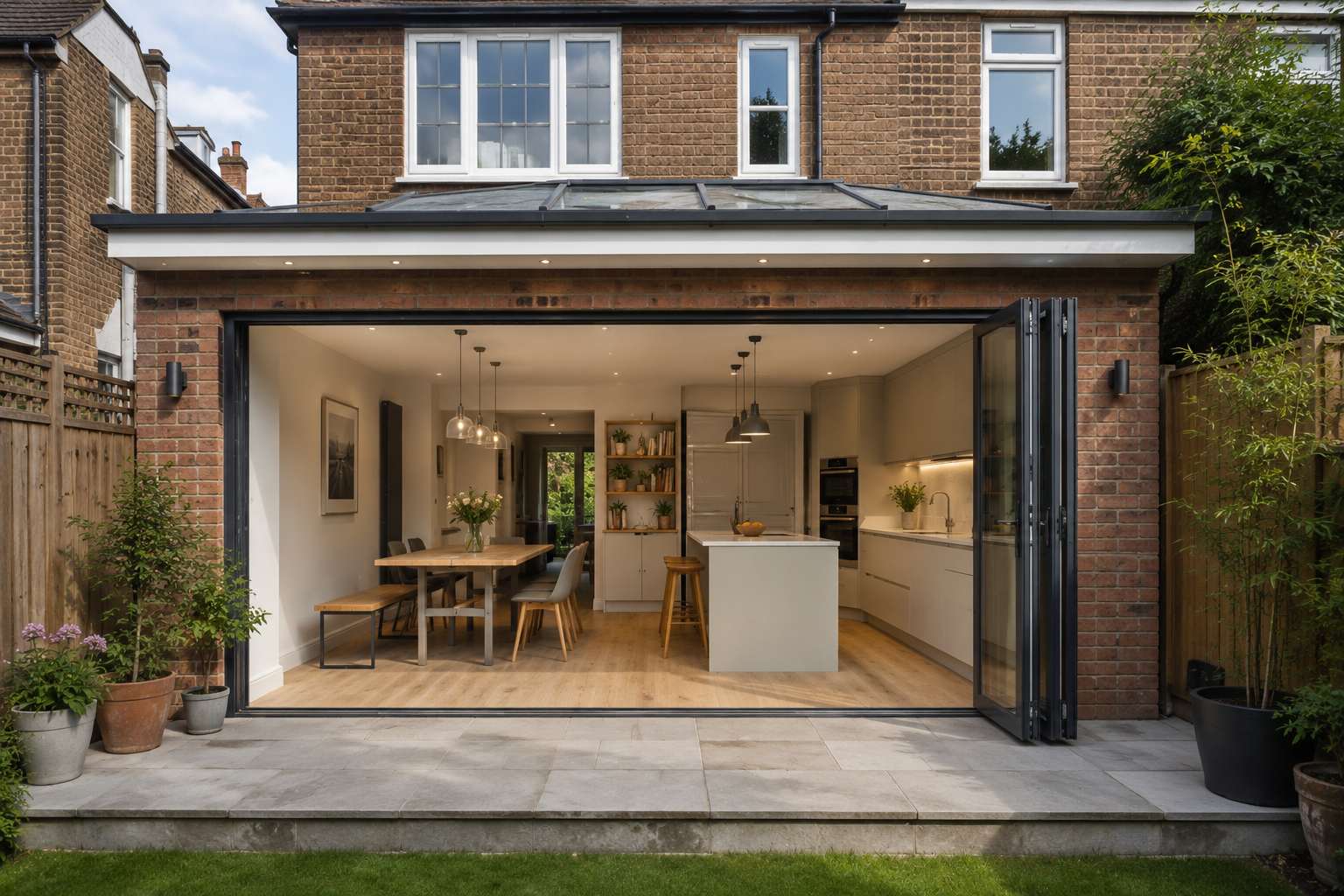
London property has a habit of making financial decisions look straightforward in hindsight. Buy, improve, hold — and the numbers tend to work in your favour. But the more interesting question for many homeowners right now isn’t whether to sell and move, it’s whether to stay and build.
With moving costs — stamp duty, agent fees, legal costs, the stress of a chain — routinely running into tens of thousands of pounds, extending or rebuilding in situ has become an increasingly rational choice.
Extensions: More Space Without the Upheaval
The most obvious case for a house extension is simple: you get the extra space you need without leaving the neighbourhood, the school catchment area, or the home you’ve spent years making your own.
Popular projects — kitchen extensions, rear additions, loft conversions, side returns — don’t just create square footage. Done well, they fundamentally change how a home functions. A dark, underused kitchen becomes an open-plan family space. A cramped top floor becomes a proper main bedroom with an en-suite. The house you’ve outgrown becomes the house that fits you properly again.
The choice of contractor matters as much as the design itself. Experienced house building contractors understand how to balance structural requirements, planning constraints, and design ambitions — and how to do it without the project running away from the budget.
The Financial Case
London’s property market, despite its ups and downs, remains one of the strongest in the country over the long term. A properly designed kitchen extension or loft conversion can add anywhere from 10% to 25% to a property’s value depending on the area, the quality of the work, and the local market.
Location plays a significant role here. In parts of West London like Hammersmith and Ealing, where buyers are particularly quality-conscious, a premium extension spec can be the difference between achieving the asking price and not. In South London — Lambeth, Lewisham, and Wandsworth — where the market has grown rapidly over the past decade, well-executed extensions have consistently delivered strong returns as demand in these areas has increased.
New Builds: Starting From Scratch Has Its Own Advantages
For those with a site to develop — whether that’s a plot, a demolition project, or a self-build opportunity — a new build offers something an extension can’t: a completely clean slate.
Modern homes built by experienced UK building companies can be designed from the ground up to meet current energy standards, incorporate smart systems, and be precisely tailored to how the occupants actually live. There’s no compromise forced by an awkward existing layout or an old foundation that dictates what’s possible.
The practical benefits are real. Modern construction methods, materials, and insulation systems mean lower energy bills, fewer maintenance issues in the early years, and a building envelope that performs significantly better than older stock. Air source heat pumps, MVHR ventilation, triple glazing, and underfloor heating are far easier to integrate properly in a new build than to retrofit.
Location Value Works in Your Favour
One of the less-discussed advantages of building or extending in London rather than moving is that you’re staying in a market where land is genuinely scarce. Building more on land you already own is one of the most efficient uses of capital available to a London homeowner.
Navigating London’s planning system also rewards local knowledge. In North London boroughs like Camden, where conservation area policies are extensive and Article 4 Directions restrict what can be altered without permission, a contractor who understands the local authority’s priorities and preferences can mean the difference between an application that moves quickly and one that stalls for months in revisions.
Practicality and Comfort, Not Just Numbers
It’s worth saying clearly: the case for extending or building isn’t purely financial. There’s genuine value in staying in a home and neighbourhood you know, improving it to suit your life, and avoiding the disruption of a move.
A well-managed extension project — handled by an experienced building firm with a clear programme and transparent costs — typically takes three to six months. A house move, including finding the right property, negotiating, and waiting for the chain to complete, often takes longer and with far less certainty.
Whether the goal is more space, a better-performing home, or a long-term investment, building in London continues to make sense. The key is choosing contractors who know what they’re doing and can demonstrate they’ve done it before.